DRAWN PROOF GAMES
This page contains some proof games with a difference. The basic concept of proof games, the "Rubik's cube" of chess composition, is explained here, but most problems on this page have an additional constraint: namely that the game has just ended in a draw.
Could the draw be stalemate (or even dead position)? In most cases, that would be a consequence of the diagram, rather than a further constraint. Exceptionally, I suppose one might have an exotic position which is drawn only if en passant or castling is not available... hmmm, must try that some day! Anyway that's not what's going on here!
Or could the draw have been by agreement? An unwritten convention is that in a chess composition, the players may not agree a draw. (In a similar way, neither player may resign.) So the draw was by some other mechanism, not hard to find, since the game is less than 50 moves long, and we've already discussed almost all of the ways that a game can be drawn!
{A}-{C} are just appetizers, while {D}-{F} extend the ideas to slightly more complicated positions. {G}-{H} are related earlier problems by other composers, while {I}-{J} are my own responses.
| {A} Original, Nov 2001 |
{B} Probleemblad, May 2002 |
{C} Original, Nov 2001 |
||
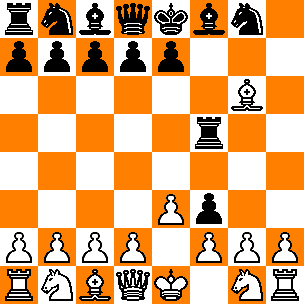 |
 |
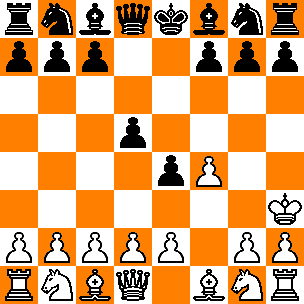 |
||
| (16+14) Drawn. Proof game in 10.5 moves. | (15+16) Drawn. Proof game in 7.0 moves. | (16+16) Drawn. Proof game in 8.0 moves. | ||
| {D} Original, Jan 2002 |
{E} Probleemblad, Jan 2002 |
{F} Original, Nov 2001 |
||
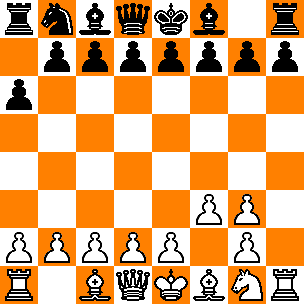 |
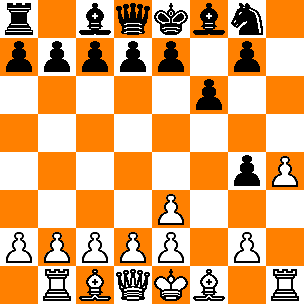 |
 |
||
| (15+15) Drawn. Proof game in 8.0 moves. | (14+14) Drawn. Proof game in 11.5 moves. | (16+16) Drawn. Proof game in 8.5. Interesting question: is this cooked? |
Peter van den Heuvel & Joost de Heer pointed out to me two earlier problems from 1997.
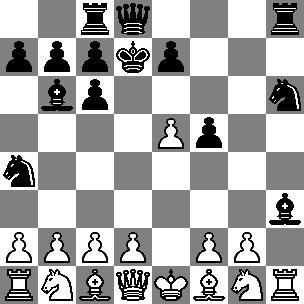
| {G} P.I.Olin Die Schwalbe, Feb 1997 |
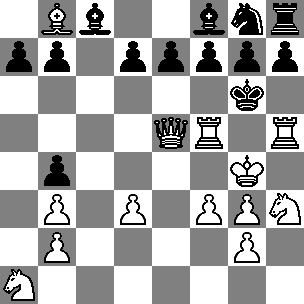
{H} A.Frolkin & S.Tkachenko Die Schwalbe, Oct 1997 |
|||
 |
 |
 |
||
| (15+14) Position after White's 15th move. Black can claim a draw by repetition with his next move. Game to Black's 11th move? | (13+13) Position after Black's 23rd move. Black played 19. ... b4. Result? |
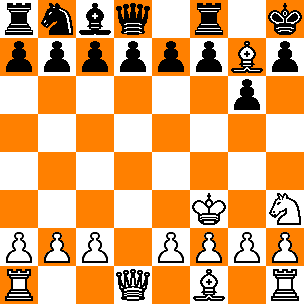
{I} is my offering along the same lines as {G}. {J} makes a point in the discussion raised by problem {F}.
| {I} Original, Jul 2002 |
{J} Original, Aug 20002 |
|||
 |
 |
|
||
| (13+15) White can draw with his next move. Proof game in 9.0 moves. | (14+14) Drawn. Proof game in 11.5. |